Christmas Candy Cane Quilting E2E
A Designer’s First Look: Charm with Clear Intent
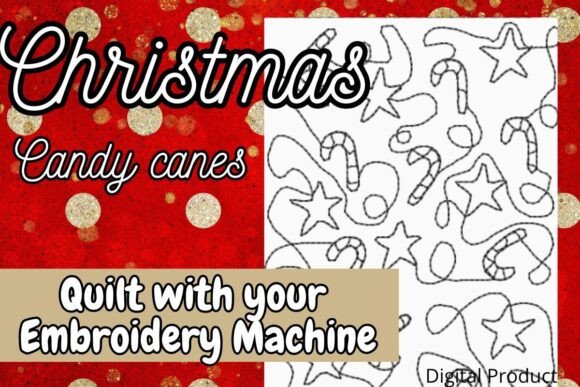
Unzipping the Christmas Candy Cane Quilting E2E file, I wasn’t greeted with over-the-top ornamentation or frantic holiday energy — just a clean, rhythmic repeat of candy canes and stars, spaced to breathe. It feels like a quiet nod to tradition, not a shout. As a designer who’s stitched hundreds of holiday motifs, I appreciate how this edge-to-edge quilting design avoids visual fatigue: no tiny bells, no tangled ribbons, no excessive fill stitch density that gums up lightweight cotton. It’s built for rhythm, not clutter — which means it’ll hold up beautifully on table mats, tea towels, and quilted pillow covers meant for real homes, not just photo shoots.
Where It Shines: Real Projects, Not Just Pixels
Last week, I used Christmas Candy Cane Quilting E2E to finish a set of linen kitchen towels for a local boutique owner. She’d already embroidered her logo in one corner — so the quilting needed to frame, not compete. The design’s balanced spacing let me run it across the towel’s lower third without overwhelming the fabric’s natural texture. Customers loved the subtle dimension it added: not “embroidered” in the bold, graphic sense, but quietly *finished*, like something made with care and intention.
It also worked well on a small-batch run of cotton-blend baby blankets — soft enough for nursery decor, structured enough to avoid puckering. Because the candy canes are stylized (not photorealistic), they read clearly even at reduced scale. That matters when you’re stitching for Etsy sellers who need consistent, shippable finished products — not fragile heirlooms that require hand-washing disclaimers.
What to Watch For: Texture, Scale, and Fabric Behavior
This isn’t a one-size-fits-all embroidery file. On textured fabrics like terry cloth or heavy canvas, the candy cane outlines can blur slightly — especially where satin stitch meets curved edges. I recommend testing on scrap first, using medium-weight cutaway stabilizer to keep those star points sharp. On stretchy knits (like sweatshirt fleece), the design holds up best when hooped with light tear-away + topping — otherwise, the running stitch elements may shift during quilting.
Dark fabrics? Yes — but choose thread colors deliberately. A stark white thread pops beautifully on navy or charcoal, but avoid pale pastels unless you’re aiming for a muted, vintage feel. And if you’re planning to use Christmas Candy Cane Quilting E2E on curved surfaces — think caps or tapered pillow covers — be mindful of distortion in the outer repeats. It’s designed for flat, stable quilting, not 3D conforming.
Stitch Density & Practical Performance
The fill stitch areas are generous but not dense — ideal for breathable cottons and linens. I’ve seen too many holiday designs turn stiff and plasticky after washing; this one stays pliable. That’s critical for handmade products meant to be used: tea towels that dry dishes, aprons that catch flour, tote bags that carry groceries. The running stitch accents between motifs add movement without adding bulk — a smart detail for designers who value both aesthetics and function.
That said, avoid layering it directly over dense applique or heavy text. The design reads best as a background or finishing element, not a top-layer focal point. Think of it as the “stitching equivalent of a well-placed border” — supportive, intentional, never demanding center stage.
For Sellers & Small Business Owners: Trust, Value, and Brand Fit
If you’re an Etsy seller or craft fair vendor, Christmas Candy Cane Quilting E2E adds quiet professionalism to your listings. It doesn’t scream “holiday sale!” — it whispers “thoughtfully made.” That builds trust. Buyers recognize craftsmanship in restraint: clean lines, consistent spacing, and motifs that enhance rather than dominate. When paired with neutral-toned fabrics and quality thread, it elevates a simple tea towel into a personalized gift — one customers proudly display, not stash in a drawer.
For apparel decorators, it’s strongest on relaxed-fit items: oversized sweatshirts, canvas totes, denim aprons. Avoid tight-fitting tees or delicate baby onesies unless you reduce the repeat scale significantly — and even then, test stitch density carefully. This is a quilting design, not a standalone motif, so its strength lies in repetition and rhythm, not isolated impact.
Designer Notes You Can’t Skip
- Always test on scrap fabric — especially with your exact stabilizer combo and thread brand.
- Check contrast in both black-and-white and color mockups — some thread shades lose definition on busy prints.
- Review stitch density before scaling down; reducing size too far can collapse fine details.
- Confirm hoop size compatibility — edge-to-edge quilting often requires larger hoops or multi-position setups.
- Inspect small star points and candy cane curves at 200% zoom in your embroidery software — look for skipped stitches or jagged vectors.
- Verify licensing terms before selling finished items or bundling with digital products — commercial use isn’t automatic.
- Compare performance on light vs. dark backgrounds — thread sheen changes dramatically depending on fabric tone.
Final Thought: A Design That Serves the Project
Christmas Candy Cane Quilting E2E won’t win awards for novelty, and it shouldn’t. Its value is in reliability — in how it looks after five washes, how it photographs on a handmade product listing, how it feels under fingers on a cozy blanket. It’s the kind of embroidery file that disappears into the work while making everything around it feel more complete. For designers, craft business owners, and makers who prioritize longevity over flash, it’s not just another holiday download. It’s a quiet tool — well-shaped, thoughtfully paced, and ready for real use.