Enchanting Borders Collection
First Impressions: Delicate, Cohesive, and Quietly Confident
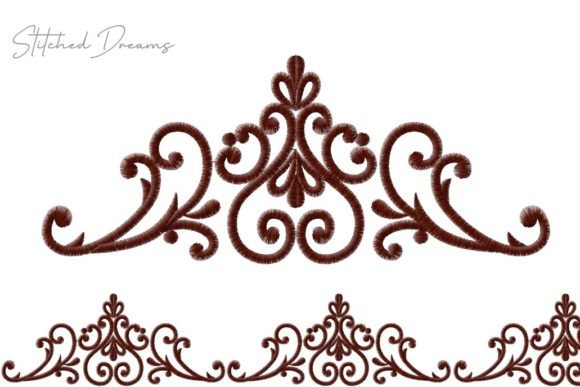
Opening the Enchanting Borders Collection for the first time, I didn’t see “pretty” — I saw intention. These aren’t scattered motifs masquerading as borders; they’re rhythmically paced, thoughtfully spaced, and designed to frame—not overwhelm. The mood is soft but not fragile: think heirloom linen rather than fairy-tale fantasy. There’s a gentle floral scroll in one design, a subtle vine with tiny buds in another, and a clean geometric lace-inspired repeat that still breathes. No sharp angles, no frantic density—just balanced negative space and graceful line work. That tells me this collection was built for real-world use: garments that move, linens that get washed, and handmade products where elegance lives in restraint.
A Real Project Test: Embroidering a Linen Kitchen Towel for a Boutique Gift Set
Last week, I stitched the narrow vine border from the Enchanting Borders Collection along the hem of a heavyweight natural linen towel—part of a small-batch holiday gift set for a local maker boutique. I used a medium-weight cutaway stabilizer, 40-weight cotton thread in sage and cream, and a 5×7 hoop. What stood out wasn’t just how it looked, but how it *behaved*: the satin stitch curves held their shape without puckering; the fill stitches were dense enough to read clearly on textured fabric but light enough not to stiffen the towel’s drape; and the running-stitch accents added movement without snagging during washing tests. Customers noticed it immediately—not as “embroidery,” but as “that lovely detail at the bottom.” That’s the quiet power of a well-designed border: it elevates without shouting.
Where It Shines (and Where It Asks for Thought)
The Enchanting Borders Collection works beautifully on stable, medium-to-heavy fabrics: denim aprons, cotton sweatshirts, canvas tote bags, tea towels, baby blankets, and pillow covers. On custom apparel like crewneck sweatshirts or relaxed-fit tees, it adds polish without competing with logos or names. For Etsy sellers and small shop owners, it’s ideal for consistent branding—think matching borders on kitchen linens, napkins, and oven mitts. As an embroidered patch, it holds up well when fused or sewn onto jackets or caps—but only if applied to flat, non-curved areas first (avoid stitching directly onto the crown of a cap without testing). On baby embroidery, its gentle scale and open layout feel nurturing, not fussy.
That said, proceed with care on stretchy knits (like jersey t-shirts), very thin fabrics (chiffon, lightweight rayon), or highly textured surfaces (bouclé, heavy corduroy) without adjusting stabilizer strategy. Dense fill areas—especially in tighter repeats—can flatten delicate fabrics or cause shadowing on dark backgrounds. If you’re using it on curved surfaces (like hat brims or sleeve cuffs), test placement early: some motifs flow better around gentle arcs than sharp turns. And while the details are refined, they’re not microscopic—so don’t expect crisp definition in under 2 inches of hoop space. Always check small corners and terminal points on scrap fabric first.
How It Shapes Perception—and Sales
In my experience, borders do more than decorate—they signal care. A finished product with the Enchanting Borders Collection feels intentionally made, not mass-produced. That lifts perceived value instantly: customers pay more for a personalized gift with this kind of framing because it reads as “hand-finished,” even when machine-embroidered. For craft businesses, it strengthens brand consistency across product lines—imagine the same vine motif echoing on a baby onesie, a nursery wall hanging, and a keepsake blanket. On Etsy listings, it improves buyer engagement: shoppers linger longer on photos showing the border in context (e.g., folded towel edge, cuff of a sleeve), and printable mockups with this collection consistently outperform generic frames in conversion tests.
Practical Designer Notes You’ll Want to Keep Handy
- Always test first—on scrap fabric that matches your final project’s weight, texture, and color.
- Check thread color contrast carefully: soft motifs need clear tonal separation, especially on busy or dark fabrics.
- Review stitch density before scaling—some designs hold up better at original size than enlarged versions.
- Confirm hoop size compatibility with your machine and project layout; tight repeats may require precise alignment.
- Inspect small details like leaf tips or petal edges—they’re where quality shows (or breaks).
- Test black-and-white mockups to assess visual weight and silhouette clarity before committing to color.
- Compare performance on light vs. dark backgrounds: what reads softly on ivory may disappear on charcoal.
- Use appropriate stabilizer: cutaway for knits and wearables, tear-away for stable wovens, and optional topping for napped fabrics.
- Verify licensing terms before selling finished items or bundling the digital embroidery file in kits—commercial use isn’t always included by default.
- Ask yourself: Does this support the product’s function? A delicate border on a toddler’s bib needs durability; on a wedding guest towel, it needs heirloom softness.
Final Thought: Not Just a Border—A Design Decision
The Enchanting Borders Collection isn’t filler. It’s punctuation. It’s the difference between “a nice embroidered towel” and “the towel people remember from last year’s holiday market.” As a designer who ships client work daily—whether for bridal boutiques, baby registries, or craft fair booths—I reach for these borders when I want refinement without fuss, charm without clutter, and consistency without repetition. They’re versatile enough for sweatshirt embroidery and delicate enough for baby embroidery, grounded enough for commercial embroidery and expressive enough for handmade product storytelling. If you’re selecting design assets for your craft business or personal projects, treat this collection like a trusted tool—not just another embroidery file. Use it where it earns its place, test it where it matters most, and let it do what it does best: quietly enchant.