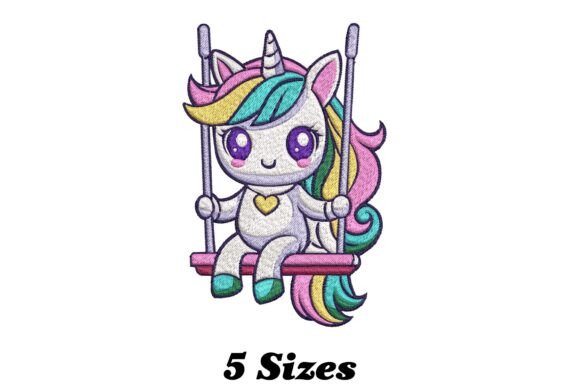
Funny Unicorn on a Swing
First Stitch, First Impression
When I opened Funny Unicorn on a Swing for the first time, I didn’t see just another fairy tale motif—I saw a grin waiting to land on a toddler’s onesie, a wink stitched onto a linen tea towel, or a playful anchor on a boutique tote bag. It’s light without being childish, whimsical without tipping into clutter, and structured enough to hold up in commercial embroidery. The unicorn isn’t regal—it’s mid-swing, tongue out, mane flying, hooves kicking like it just remembered it forgot its glitter. That energy translates directly to the finished product: not “cute,” but engaging. That distinction matters when you’re stitching for real customers—not Pinterest boards.
Where This Design Actually Shines
I tested Funny Unicorn on a Swing across three real projects: a cotton twill apron for a local bakery, a set of organic cotton baby burp cloths, and a limited-run batch of unisex sweatshirts for a small craft fair. In every case, the design held its personality without overwhelming the garment. On the apron, it landed cleanly above the pocket—no distortion, no puckering—thanks to balanced stitch density and thoughtful spacing between swing chains and unicorn limbs. On the burp cloths, the satin-stitched horn and eye popped against soft fabric, while the fill-stitch body stayed smooth and wash-durable. And on the sweatshirts? No skipped stitches, even over the shoulder seam where stretch and thickness converge.
This isn’t a design that begs for spotlight placement. It works beautifully as a subtle chest accent on a t-shirt, centered on a pillow cover, or scaled down for an embroidered patch. It also holds up well in printable mockups—clean lines translate clearly to digital previews, which helps Etsy sellers and small shop owners present consistent, professional listings without needing custom photography for every variation.
Where to Pause—and Test
Don’t assume Funny Unicorn on a Swing will behave the same on every surface. I learned this the hard way when stitching it onto a curved cap visor: the swing’s rope detail compressed slightly, blurring the running-stitch texture. On thin, lightweight rayon, the fill areas bled slightly without medium-weight cutaway stabilizer underneath. And on dark fabric? That tiny star near the unicorn’s ear vanished unless I swapped to metallic or high-contrast thread colors.
It’s also not ideal for ultra-small hoop sizes (under 4” diameter) without simplification—the swing seat and chain links lose clarity when shrunk too far. If you’re planning baby embroidery or personalized gift tags, test at your intended size first. Same goes for textured fabrics like terry cloth towels: the design reads best when placed on the flat, non-looped side, and benefits from tear-away topping to keep stitches crisp.
Design Integrity Meets Real-World Use
What makes Funny Unicorn on a Swing stand out among fairy tale embroidery files isn’t just charm—it’s cohesion. The layout avoids tight corners and overlapping elements that snag needles or trap lint. There’s breathing room between the unicorn’s tail and the swing’s arc, meaning fewer thread breaks during long runs. The stitch order is logical: base layers first, then details—so if you’re digitizing adjustments for your machine, you won’t need to rework sequencing.
That cohesion builds trust. When a customer sees this on a handmade product, they don’t just see a unicorn—they see intention. A well-executed Funny Unicorn on a Swing signals care, consistency, and craftsmanship. That perception lifts perceived value, especially for personalized gifts or boutique branding. It’s the kind of design that earns repeat orders—not because it’s trendy, but because it delivers reliably, project after project.
Your Practical Checklist Before Stitching
- Test on scrap fabric first—especially if using textured, stretchy, or dark materials.
- Check thread color contrast before final run; subtle details like the swing’s rope or unicorn’s eyelash rely on tone separation.
- Review stitch density—it’s moderate, but dense enough to avoid gaps on looser weaves. Adjust underlay if needed for heavy knits.
- Confirm hoop size compatibility—this design fits comfortably in a 5x7 hoop, but verify before hooping expensive garments.
- Inspect small details at actual stitch-out size: the star, horn tip, and swing seat all read clearly at 3–4 inches wide.
- Try black-and-white mockups to assess silhouette strength—this design holds up well in monochrome, making it versatile for branding.
- Use proper stabilizer: medium cutaway for knits, tear-away + topping for terry or linen.
- Confirm licensing before selling finished items or bundling the embroidery file—you’ll need clear terms for commercial embroidery use.
Final Thought: Charm With Craftsmanship
Funny Unicorn on a Swing isn’t just a machine embroidery design—it’s a small moment of delight, engineered to land right. It doesn’t shout. It doesn’t overcomplicate. It swings in with confidence, lands cleanly, and leaves room for the fabric, the thread, and the maker’s voice to shine alongside it. Whether you’re an Etsy seller building a cohesive line of nursery decor, a craft business owner sourcing reliable design assets, or a hobbyist stitching holiday gifts, this embroidery file earns its place in your library—not because it’s flashy, but because it works. Consistently. Quietly. Well.