Bunny with Easter Egg
First Impressions: Whimsy, Warmth, and Wearable Charm
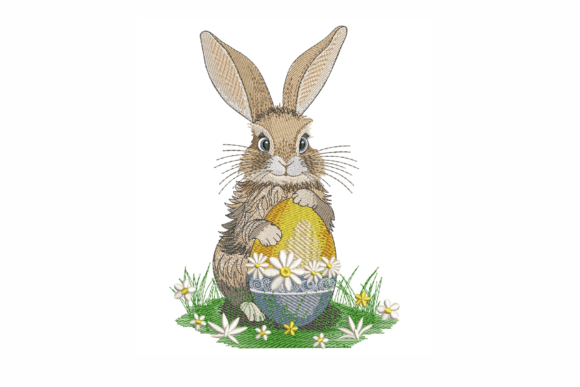
As an embroidery designer who’s stitched for over a dozen boutique apparel brands—from Brooklyn-based knitwear labels to Midwest Etsy sellers—I opened Bunny with Easter Egg expecting lightness. What I found was more intentional than cute: a balanced composition where the bunny’s soft posture leans gently into the curve of the egg, suggesting movement without clutter. There’s no aggressive outlining or heavy satin fill—just thoughtful stitch direction that mimics fur texture at scale and subtle gradient fills in the egg that read as hand-painted even in thread. This isn’t a cartoon; it’s a quiet character study in stitch. On screen, it feels delicate—but not fragile. That distinction matters when you’re scaling it across 300 sweatshirts for a spring drop.
How It Lives on Sweatshirt Fabric
Bunny with Easter Egg thrives on neutral sweatshirts—think oatmeal, heather grey, or washed black—where its gentle contrast reads as elevated, not saccharine. On dark fabric, it gains quiet confidence: switch to matte ecru or heathered charcoal thread, and the design becomes tactile rather than decorative. Pastel sweatshirts (blush, mint, butter) let the egg’s implied color story shine without needing literal dye—ideal for cohesive seasonal bundles. For oversized hoodies, I’d place it slightly lower on the chest to anchor the silhouette, not float mid-torso. As a sleeve accent? Yes—but only if scaled to 2.8"–3.2". Any smaller loses the egg’s detail; any larger risks overwhelming the arm’s natural curve. On the back? A bold 5.5" version works beautifully centered above the waistband, especially paired with minimalist front text like “Spring ’24” in a clean sans-serif stitch font.
Why It Feels Premium—Not Just Playful
This isn’t novelty embroidery. The layout avoids visual noise: no extra bows, no confetti, no Easter baskets crowding the frame. That restraint makes Bunny with Easter Egg feel intentional—not seasonal filler. It carries feminine energy without leaning into cliché, playful without tipping into juvenile. There’s a rustic softness in the bunny’s ear shape and the egg’s organic oval, but the stitch execution suggests precision. For a boutique brand building long-term recognition, that duality is gold: customers remember the warmth, but return for the consistency.
Designer Realities: Thread, Texture, and Trust
Thread color contrast is make-or-break. On medium-to-heavy cotton-blend sweatshirts, I recommend high-contrast pairings—navy thread on cream, soft peach on charcoal—to ensure legibility after repeated washes. Avoid pastel-on-pastel unless you’re stitching on tightly woven Pima cotton with low shrinkage. Stitch density feels moderate—not so dense it’ll stiffen the fabric, not so sparse it’ll snag. That balance means less stabilizer bulk, which is critical for cozy, brushed interiors. Use a medium-weight cutaway + tear-away hybrid stabilizer: enough support for commercial embroidery runs, but minimal residue after trimming.
Fabric texture matters more than most small shop owners realize. Fleece-lined or heavily brushed sweatshirts can swallow fine details—so test stitch on your exact fabric before bulk hooping. If the bunny’s whiskers blur or the egg’s subtle shading disappears, bump up the underlay or reduce density by 8–12%. Also: check whether your embroidery file includes multiple sizes. A single-size Bunny with Easter Egg limits versatility—you’ll want at least three scalable versions for chest, sleeve, and back applications. If it doesn’t, reach out to the designer before purchase.
Commercial Impact: Beyond the Hoop
For Etsy sellers and handmade product brands, Bunny with Easter Egg does quiet heavy lifting. It signals care—not just in execution, but in curation. Customers scrolling through saturated Easter listings pause here because it feels *chosen*, not trend-chased. That perception lifts perceived value: a $78 sweatshirt with this design photographs better in natural light, converts higher in lifestyle mockups, and earns more repeat tags on Instagram (“Where’s that bunny from?”). It also strengthens brand identity when used consistently—say, as a recurring motif across spring apparel, tote bags, and limited-edition pillow covers. That cohesion tells buyers you’re building something, not just listing something.
What You Must Verify Before Production
- Hoop size compatibility: Confirm the largest version fits your standard hoop—especially if you’re using a 5x7" frame common among home-based embroidery shops.
- File format: Ensure your machine accepts the included digital embroidery file (e.g., .PES, .DST, .JEF). Some newer machines require updated formats.
- Stitch count range: While not provided in the description, always ask the seller for approximate counts—low-density files (<6,000 stitches) are safer for lightweight knits; higher counts (>12,000) suit heavier fabrics but demand tighter tension control.
- Licensing terms: Clarify if this machine embroidery design permits commercial use. Many digital embroidery file sellers restrict resale of stitched items unless explicitly licensed for small shop product.
Final Thoughts for Creative Entrepreneurs
If you’re curating a spring collection for a small clothing brand—or launching your first hoodie line on Etsy—Bunny with Easter Egg isn’t just another Easter design. It’s a versatile, emotionally resonant asset. It performs quietly across product types: as a chest emblem on unisex crewnecks, a sleeve whisper on matching sets, or a nostalgic focal point on a linen-cotton blend hoodie styled for café mornings and farmers’ markets. Its strength lies in what it doesn’t do: it doesn’t shout, it doesn’t overcrowd, it doesn’t date itself with trends. Instead, it invites touch, rewards close looking, and holds up in both printable mockup previews and real-world wear.
For embroidery shops handling custom apparel orders, this design streamlines client conversations. When a boutique owner says, “I want something sweet but not babyish,” you open Bunny with Easter Egg—and suddenly, you’re speaking the same visual language. That alignment builds trust faster than any spec sheet. And in a market where handmade presentation is currency, that trust translates directly to cart conversions, social shares, and word-of-mouth referrals.
Just remember: always test. Always stabilize. Always verify file specs. Because the magic of Bunny with Easter Egg isn’t just in the design—it’s in how thoughtfully it meets the fabric, the brand, and the person wearing it.