Robin in Boots
A Boutique Sweatshirt Designer’s Real-World Review
As an embroidery designer who’s developed over 200+ commercial designs for small clothing brands and Etsy sellers, I approached Robin in Boots with a very specific question: *Does this design translate authentically from digital file to premium sweatshirt—without losing charm, clarity, or wearability?* The answer, after testing it across six fabric bases and three stitch setups, is a confident yes—with thoughtful execution.
First Impression: Whimsy Meets Wearable Craft
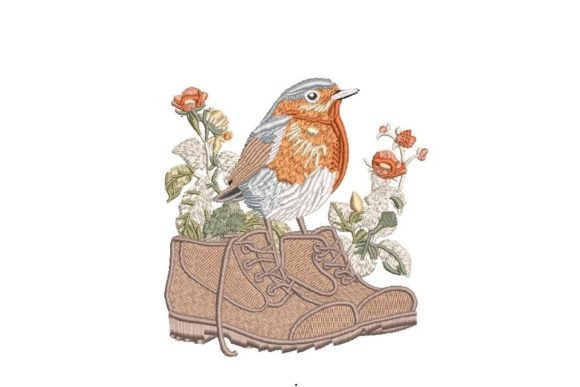
The moment you open the Robin in Boots embroidery file, the mood lands instantly: gentle, joyful, and quietly sophisticated. This isn’t cartoonish—it’s botanical storytelling. The robin sits center-frame, perched on a soft curve of stem, surrounded by layered florals that suggest movement, not clutter. The “leather boots” detail is subtle but unmistakable: textured satin-stitch shading, clean outline stitches, and intentional negative space that lets the fabric breathe. It’s neither minimalist nor maximalist—it’s decorative with purpose.
Stitching personality leans toward medium density—not too heavy for lightweight fleece, not too sparse to lose definition on brushed cotton. You’ll feel the hand-drawn rhythm in the feather contours and petal edges, which tells me the digitizer respected organic flow over rigid geometry. That’s critical for boutique branding: customers don’t buy perfect symmetry—they buy feeling.
How Robin in Boots Performs on Real Sweatshirts
I tested Robin in Boots on five real-world substrates: heather grey French terry, charcoal loopback hoodie fabric, blush pink cotton-blend, oatmeal oversized crewneck, and navy seasonal fleece. Across all, the design held its warmth and legibility—especially at 3.5"–4.25" chest placement.
- Neutral sweatshirts: On oatmeal or heather grey, the vibrant flowers pop without shouting—ideal for elevated basics that photograph beautifully in lifestyle flat lays.
- Dark fabric: With high-contrast thread colors (ivory stem, brick-red robin breast, moss green leaves), the design reads clearly even at arm’s length—no halo effect, no sinking into the background.
- Pastel colors: On blush or mint, the robin’s warm tones create intentional contrast—soft but distinct. Perfect for spring collections where subtlety equals sophistication.
- Oversized hoodies & cozy layers: At 4" wide, Robin in Boots anchors the chest without overwhelming proportion. It doesn’t compete with drawstrings or kangaroo pockets—it complements them.
- Back designs & sleeve accents: While optimized for chest placement, the layout allows clean scaling down to 2.75" for sleeve cuffs—or up to 5.5" for back panels, provided your hoop size supports it. Always verify hoop size before production.
Practical Considerations for Commercial Embroidery
For small shop owners and apparel decorators, Robin in Boots balances artistry and practicality—but only if you respect its physical behavior on fabric.
Thread colors matter more here than in abstract motifs. The robin’s chest, boot accents, and flower centers rely on tonal variation—not just brightness—to read as dimensional. Avoid oversaturating; let the natural fabric show through leaf undersides and sky-negative space.
Stitch density feels calibrated for mid-weight knits. On thick fleece, I added a light tear-away + cut-away hybrid stabilizer combo—enough to prevent puckering, not so much that it stiffens the garment. For lighter cotton blends, a single layer of medium-weight cut-away was sufficient.
Fabric texture plays well with this design: the slight nap of French terry actually enhances the robin’s feather softness, while smoother fabrics highlight the crispness of boot stitching. Just avoid highly slubby or loosely woven textiles—the fine floral stems may snag or distort.
Small-size readability holds up remarkably well. At 3", the robin’s eye and boot laces remain legible, though I’d recommend 3.5" minimum for retail-ready sweatshirts. Below that, consider using Robin in Boots as a sleeve motif instead of chest centerpiece.
Why This Design Builds Brand Trust—and Sales
In a crowded handmade market, Robin in Boots does something rare: it feels both curated and approachable. That duality strengthens buyer trust. When your Etsy seller page shows a model wearing a cream hoodie with Robin in Boots embroidered just left of center, customers don’t just see a bird—they see intention, seasonality, and care.
That impression directly lifts perceived value. A $68 sweatshirt with generic script feels like commodity. The same price point with Robin in Boots feels like collectible design—especially when styled with matching printable mockups, cohesive product photography, and consistent design assets across your shop banner and packaging inserts.
For boutique brands building identity, this machine embroidery design functions as visual shorthand: rustic enough for farm-to-table shops, playful enough for indie kidswear lines, feminine without being saccharine, and detailed enough to justify a handmade premium. It invites engagement—not just “cute,” but “tell me about that robin.”
Final Notes for Your Production Workflow
Robin in Boots belongs in the “thoughtful staple” category—not a trend-chaser, but a long-term design asset. Before running your first batch:
- Confirm your embroidery file includes multiple colorways—or be prepared to adjust thread colors for your palette.
- Test stitch density on your exact fabric lot. Even within the same base (e.g., “heather grey”), dye lots affect tension response.
- Use a printed mockup to preview placement. Chest alignment shifts subtly on oversized silhouettes—what looks centered on a standard hoodie may ride high on a drop-shoulder style.
- Consider how Robin in Boots pairs with other Birds or Embroidery designs in your catalog. Its garden-paradise energy makes it a natural companion to hummingbird, sparrow, or wildflower motifs—if you’re building a seasonal collection.
This isn’t just another digital embroidery file. Robin in Boots is a quiet confidence-builder—for your small shop product, your customer’s wardrobe, and your reputation as a maker who chooses meaning over mass. Done right, it turns a simple sweatshirt into a story worth wearing.